Wednesday, January 29, 2014

Neill’s Garden: Part III

In Neill’s Garden: Part I and Part II my friend John and I assessed Neill’s corner lot, we designed a hardscape to support pots by the entrance, started to plant the softscape and dug out an area by the entrance to place the hardscape in.


On our next visit we picked up materials to contain the hardscape and prevent weeds form growing including: weed barrier fabric, fabric pegs, terrace board and stakes.


We also picked up the hardscape materials including: 1/4” crushed rock, 3/4” clean crushed rock and flagstones.


1/4" Crushed Rock


3/4" Clean Crushed Rock


We placed the terrace board along the edge of the hardscape dirt edge and cut it to fit. We packed down soil on both sides to stabilize it and anchored each end with a stake.


We then laid the weed barrier to fit the shape of the hardscape area. The fabric wasn’t long enough, so we  doubled it up. We then tacked it down to hold it in place.


We poured in the 1/4” crushed rock to create a base allowing the heavier materials to settle and stabilize. Next we poured the 3/4” clean crushed rock, which act as a second base to support the flagstones. The small rocks lock together allowing the flagstones to stay in place.


Next we placed the different shaped flagstones together to form the top of the hardscape. Additional 3/4” rock was added underneath each stone to level them. The flagstones were shifted back and forth to create a snug fit, which helped the 3/4” rock lock together. We repeated the process with each flagstone leaving room for the sprinkler head in lower left hand corner of hardscape.


Running out of time and materials, John and I had to return later to complete the hardscape. We poured  3/4” clean rock between the cracks of the flagstones to hold them in place. Then used our hands and fingers to push the small rock together, then put pressure on each flagstone to ensure it held its place. Once the hardscape was completed we discussed removing the nandina bamboo with Neill and discovered he had it cut to resemble his neighbor’s box hedges, so we removed it to plant a box hedge for him later.


Next time John builds a small rock garden to accent the corner of the lot and we'll plant more of the softscape.

Saturday, January 18, 2014

Neill’s Garden: Part II

In Neill's Garden: Part I, John and I assessed Neill's corner lot, developed a hardscape to support a combination of pots by the entrance and selected some plants for a softscape.

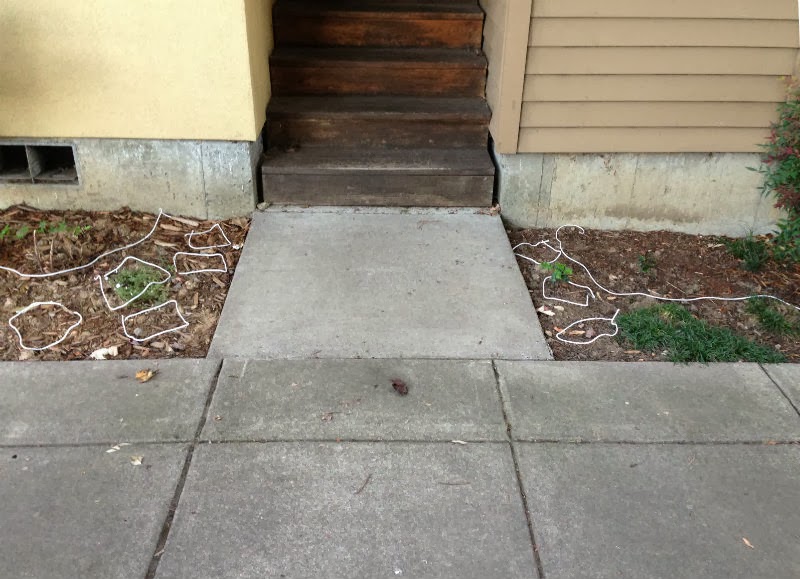
John and I returned to start the hardscape and plant our selections for the softscape. First we dug  around the entrance to lay the hardscape. We had to remove the maple growing to the left of the entrance. At the time we weren't sure if the nandina bamboo to the right would be removed. We laid rope out on our previous visit to mark the edge of the hardscape with outlines representing a few flagstones.


We removed the maple by first digging around the root base. Then cut back the limbs to pull it out of the ground.


Next we dug down about four inches where the hardscape materials would lie. Since we wouldn’t complete it this day we taped off around the holes to warn others of the uneven terrain.


We started work on the softscape with the fatsia, aucuba and yew we had picked out previously.

Japanese Plum Yew - Cephalotaxus H. 'Fastigiata'


Aucuba J. 'Rozannie'


Aucuba and Fatsia Japonica


We dug holes for each plant, which measured twice the size of the pots. We added potting soil to add fertilizer and mixed it with the old soil. Then added water to settle the dirt to prevent the plants from sinking deeper into the ground.


The softscape starts to come to life. You can see the foliage on each plant adds differing textures and form.


Join us next time when we install the hardscape.


Sunday, December 29, 2013

Neill’s Garden: Part I

As I continue my adventures in gardening I find there are two things that challenge the gardener. The first is to understand the plants needs and matching it to the right environment so it will thrive. The second, is blending color, form and texture to create a visually and aesthetically pleasing environment you enjoy.

My friend Neill tried his hand at gardening this past season, but had little success and found it frustrating. He asked if I could help out and as my experience is limited I asked my friend John of John’s Garden posts to help out.


John and I surveyed the garden. Neill’s property sits in an urban setting on a corner lot. The beds measure about four feet in width from building to sidewalk. Parking strips line both sides of the property between streets and sidewalk. Flagstones in the parking strips act as paths and add texture to the landscape. Tall maples create a shady environment, but the street corner gets direct light from a southern exposure.


Neill planted ornamental sedge grass along one of the parking strips. 


We met with Neill to understand his concerns and wants for his garden. He wanted something that blended in with the neighbors gardens, since the buildings share a similar architecture. He also liked his neighbor's use of pots to add height and dimension to their landscapes. Another important factor for him was a low maintenance garden.

John and I recommended either a three-pot or two-pot combination to line the entrance and break up the straight lines. A hardscape would need to be installed under them for support. John suggested a tall plant form to grow up the blank wall to the left of the entrance and break up the solid space. Since Neill also wanted low maintenance plants, hardy, drought tolerant plants were in order. John suggested evergreens that would keep their color and texture through winter.

We selected this Cephalotaxus H. 'Fastigiata' or Japanese Plum Yew to work as an eye catcher as it grows up the blank wall to the left side of the building's entrance. It's height should get to ten feet tall and its unique form adds texture.


Three of these Aucuba J. 'Rozannie' will add texture and form with their pointy leaves.


This Fatsia japonica adds a tropical form with broad evergreen leaves.


Next we outlined a visual pattern for the hardscape with the intent to use flagstones to mirror the parking strip and create a base support for the pots.


We found these rustic-looking pots that would contrast from the modern architecture.


I created a drawn rendition so Neill could see the effect these pots and the hardscape would create by the entrance.


Next post we start the hardscape and position the plants for the softscape.